
The Most Real Conversation About Breast Health: Meet Gina Lamanna, the Cancer Survivor Reclaiming Her Power Through The Fondle Project
After surviving breast cancer, stylist and advocate Gina Lamanna knew that “moving on” wasn’t enough. What came next was a reckoning — with her body, with silence around breast health, and with the ways women are taught to disconnect from their own physical intuition.
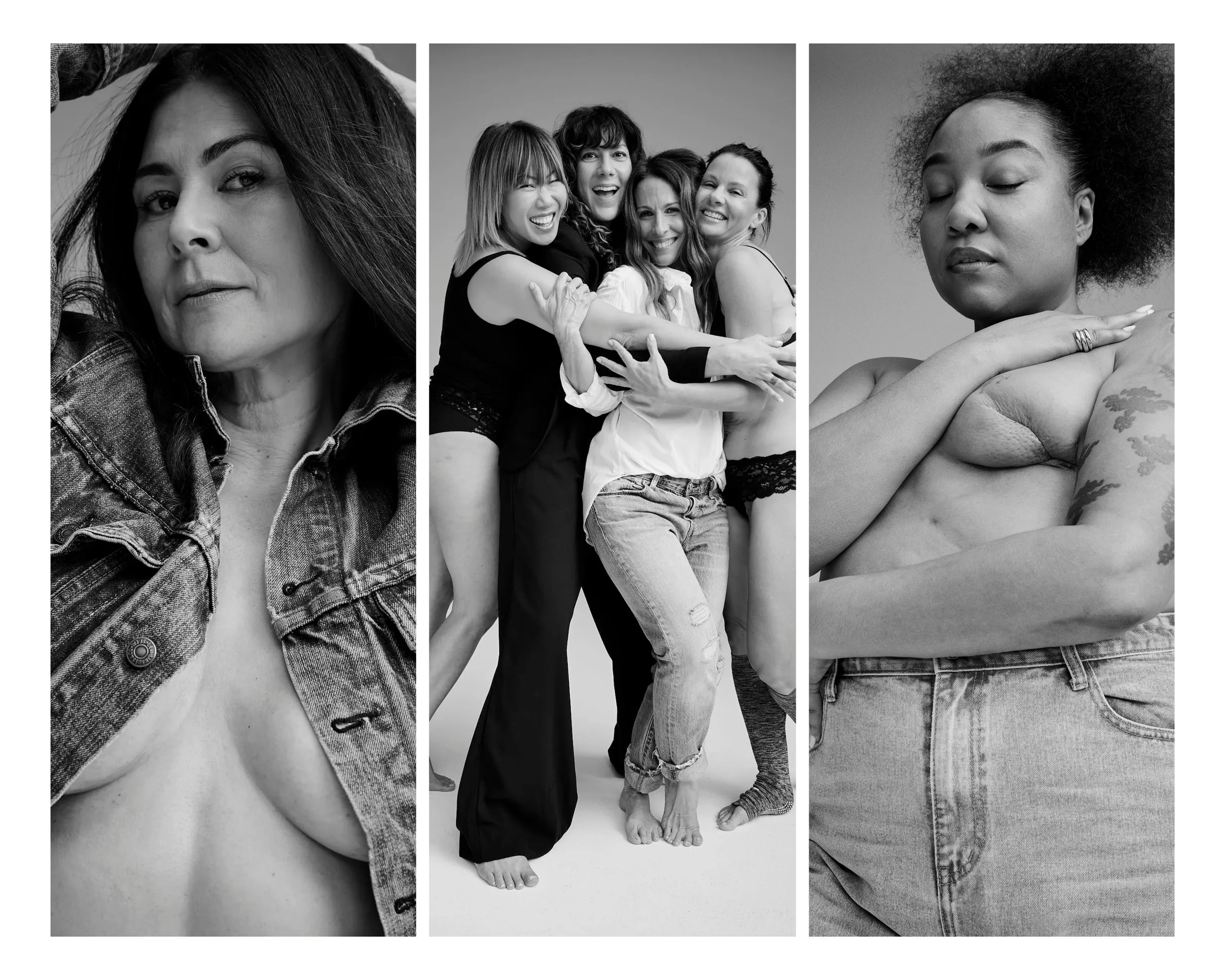
In this candid episode of The SEAM Podcast, Gina sits down with Amy Cohen Epstein, founder of the Lynne Cohen Foundation, to talk about survivorship beyond the finish line. Drawing on more than 25 years in fashion and her lived experience as a cancer survivor, Gina shares how The Fondle Project was born — a body-positive, education-driven movement that empowers women to know their breasts, advocate for their health, and reclaim confidence in bodies shaped by illness, scars, and change.
Amy: Hi everyone. Welcome. This is Amy Cohen Epstein, and this is The SEAM Podcast. This is going to be a really fun conversation about boobs. Yes. I’m here today with Gina Lamanna and we are going to talk about life, but really we’re going to focus on boobs.
Gina: Okay, so this is the most fun.
Amy: It’s the most fun. And I’m not joking—this is a really important conversation. We’re going to talk about breast health, we’re going to talk about what you should know, what you should be doing, how you should be checking yourself, and we’re also going to talk about what happens when you get diagnosed and how you move through that. Gina, you are a breast cancer survivor. You are also a stylist with 25-plus years of experience, and you created The Fondle Project, which is such an amazing concept. So I want to start with—tell me what The Fondle Project is, and how it started.
Gina: The Fondle Project started because I got breast cancer. And I realized that we don’t talk about boobs. We don’t talk about breasts. We don’t talk about what they’re supposed to feel like. We don’t talk about what we’re supposed to be doing. And I also realized that I didn’t really know my own body the way I thought I did. So I wanted to create something that was empowering and educational and also—honestly—fun and not scary. Because the second you say “breast cancer,” everyone shuts down.
Amy: Totally. Or they think it’s going to be depressing, or scary, or like—“I can’t handle this.” But we have to handle it. So when you say you didn’t know your own body the way you thought you did, what do you mean?
Gina: I mean I didn’t know what my “normal” was. I didn’t know what was normal for me, what was a lump, what was dense tissue, what was a change. And I think women are taught to be embarrassed. We’re taught to not touch ourselves. We’re taught to not look. We’re taught to not talk about it. So then you get to a place where you’re like, “Oh, I should be doing self-exams,” but you don’t really know what you’re doing, and you don’t know what you’re feeling for.
Amy: Yes. And also, people don’t want to do it because it’s intimidating. Or they don’t want to find something. But the truth is—finding something early is everything. And knowing what you feel like normally is everything.
Gina: Exactly. You don’t have to be afraid of your body. You should know your body. And if something changes, you should be able to say, “This is different.” And you should be able to advocate for yourself.
Amy: Okay, so let’s get practical. What does it actually mean to “know your normal”? Like, what are women supposed to do?
Gina: You need to touch your breasts. You need to look at your breasts. You need to do it consistently enough that you know what’s normal for you. And I always tell women: you’re not looking for “a lump.” You’re looking for a change. Because sometimes it’s not a lump. Sometimes it’s skin changes. Sometimes it’s nipple changes. Sometimes it’s swelling. Sometimes it’s a texture change. So if you’re not looking and touching, you won’t notice.
Amy: I love that—“you’re looking for a change.” Because people think it’s like a marble in there, and it’s not always like that.
Gina: Right. And also breasts are not uniform. They’re not symmetrical. They’re not the same person to person. So you have to know your body.
Amy: And you also talk about language—like calling them boobs, breasts, whatever—but removing the shame. Because the shame is part of the problem.
Gina: Yes. The shame is a huge part of the problem. If you can’t say the word, you’re not going to talk to your doctor. If you can’t talk to your partner. If you can’t talk to your friends. And then you’re alone with it. And then you’re not advocating. And then things get missed.
Amy: Okay. I want to talk about your diagnosis for a second—not every detail, but enough to understand what happened. What was the moment where you realized something was wrong?
Gina: I found something. And I did what a lot of women do—I questioned myself. I minimized it. I thought, “Maybe it’s nothing.” And then I finally went in. And what I learned very quickly is that you have to push. You have to ask questions. You have to follow up. You have to not take “it’s probably fine” as the end of the story.
Amy: Yes. And I say this all the time—women get dismissed. Or they dismiss themselves. And you can’t. Especially with breast health.
Gina: Exactly. And then once you get diagnosed, it’s like your whole life changes in a second. You go from being a person with a life to being a patient. And that is such a mindf***.
Amy: It is. And it’s also identity. It’s body. It’s femininity. It’s sexuality. It’s everything wrapped up together. And I think people don’t realize that.
Gina: They don’t. And then—on top of that—you’re dealing with scars, you’re dealing with reconstruction or not reconstruction, you’re dealing with changes that are permanent. And society already tells women they’re not good enough. Then cancer comes in and literally changes your body, and you’re supposed to just be like, “Okay!” No. It’s a process.
Amy: And this is where your styling background is so interesting, because you’ve been working with women’s bodies and confidence for decades. How did that part of you intersect with survivorship?
Gina: I realized I wanted to help women feel beautiful in the body they have now. Not “when it goes back.” Not “when you lose weight.” Not “when the scars fade.” Like—now. Because you deserve to feel confident now. And also, I wanted women to see scars differently. Like, these are not something to hide. These are part of your story.
Amy: And The Fondle Project does that through campaigns, right? Like editorial-style campaigns, plus workshops.
Gina: Yes. Because visuals matter. Representation matters. If all you ever see is perfection, then you think you’re the only one who looks like you do. So we create imagery that shows real bodies. Real scars. Real changes. And we do workshops that are both educational and empowering—where women can learn how to check themselves, learn what to look for, and also talk about it openly.
Amy: I love that. Because education without empowerment doesn’t land. And empowerment without education can be fluffy. But together it’s like—okay, this is actionable.
Gina: Exactly. That’s the goal.
Amy: Okay. Let’s talk about fear for a second. Because fear is real. People don’t do this because they’re afraid. How do you deal with that?
Gina: I think you deal with fear by giving yourself information. And also by making it a normal part of your life. Like brushing your teeth. Like skincare. Like anything else you do. It doesn’t have to be a big scary moment. It can just be part of how you take care of yourself. And if you find something, you deal with it. Because avoiding it doesn’t protect you.
Amy: Yes. Avoiding it doesn’t protect you—it just delays it. And early detection matters. It matters so much.
Gina: So much.
Amy: Okay, I want to end with this. If someone is listening and they’re like, “I’ve never done a self-exam,” or “I’m scared,” or “I don’t even know where to begin,” what do you want to tell them?
Gina: I want to tell them: start now. Start today. Touch your body. Look at your body. Learn your normal. And if something feels different, get it checked. And also—don’t be ashamed. Don’t be embarrassed. These are your breasts. This is your health. This is your life.
Amy: Amen. Gina, I love you. I love what you’re doing. I love that you took something that could have been just a chapter of pain and turned it into a movement that helps other women.
Gina: Thank you. I love you too. And I’m so grateful to have this platform to talk about it, because the more we talk about it, the more we change things.
Amy: Exactly. Okay everyone—go fondle yourselves. I said it. We’re going to normalize it. We’ll see you next time.
Editor’s Note: This interview has been edited for length and clarity.