
She Lost Her Mom to Cancer. Now She’s Fighting for Yours. Meet Amy Cohen Epstein
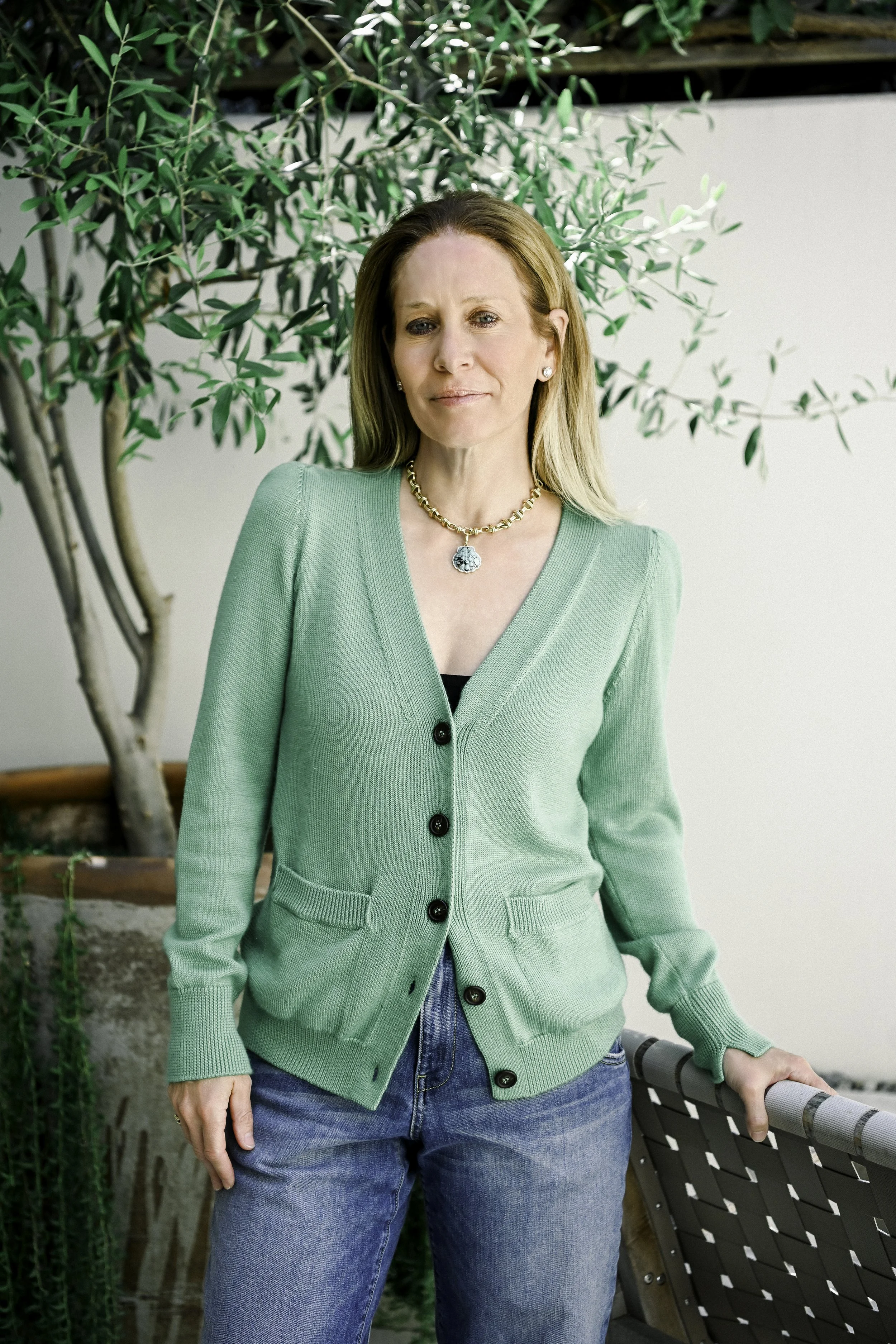
Portrait by Angie Silvy
After Amy Epstein lost her mom to ovarian cancer in 1998, grief turned into resolve. She made it her mission to ensure no other family would endure the same loss. “No daughters, no mothers, no sisters should have to go through what my family experienced—especially when so many women’s cancers are preventable and treatable with early detection,” she says.
Epstein and her three siblings founded the Lynne Cohen Foundation, which hosts the annual Kickin’ Cancer 5K, 10K, and Women’s Health Expo in Brentwood, California, where she grew up, where her mom lived, and where the memory of her mother, Lynne Cohen, remains rooted. This year’s event takes place on October 12th 2025, with the starting line on San Vicente Blvd.
“My mom was everything this event is,” Epstein says. “She was beautiful, fiercely smart, incredibly well put-together—and completely selfless. She was hands-on in everything she did, especially in the community.” Cohen died at the age of 53.
Kickin’ Cancer started as a small gathering of family and friends and has now become a multi-generational, community-wide experience that draws hundreds. Participants walk or run in teams, wear matching shirts, hold signs with names of loved ones, and write emotional messages on a tribute wall Epstein and her team created—a kind of living journal of remembrance and resilience.
Every dollar raised supports the four Lynne Cohen Foundation Preventive Care Clinics in Los Angeles and NYC. These clinics provide essential services such as free mammograms, genetic testing, and counseling to low-income women at increased risk of breast and ovarian cancer.
“These clinics are essentially on the frontlines of women’s cancer, and they’re helping to do what I first set out to do, which is save women’s lives,” Epstein says. “It’s about creating spaces where women feel seen, heard, and equipped to speak up for themselves—especially in medical settings, where women’s symptoms are still too often dismissed or minimized.”
Remembering her own mom’s horrific battle is a painful memory. “Her disease was just so brutal. She was only 48 when she was diagnosed, and it was at a late stage, and especially back in the '90s, the treatment for ovarian cancer was even more brutal.” Epstein watched a dazzling, energetic woman fade away, leaving her motherless at the age of twenty-two, just as she was graduating from Duke University. Her legacy has informed Epstein’s life work.
Lynne Cohen was known for her philanthropic energy, volunteering in her children’s schools, organizing fundraising campaigns, and becoming deeply involved in the Los Angeles art and Jewish communities. Even while fighting late-stage ovarian cancer, she worked to raise money for ovarian cancer research. “It clicked for her that research was the only way to beat this disease,” Epstein says. “That it was the future.”
Now her daughter, Amy Epstein, is that future. While pushing for additional research and funding—studies show that funding for primarily women’s diseases is far less than diseases that affect men—she has built the Lynne Cohen Foundation into an educational platform for women’s health advocacy, early detection awareness, and community-building. And this mom of three boys also hosts the SEAM podcast, which covers a wide-range of topics about women’s health.
Her message to women is to talk about what is happening in their own bodies, even if it feels embarrassing, awkward, or trifling.
“My mom had diarrhea for a year before she was diagnosed, and she didn’t tell her doctor,” Epstein says. “As women, we’re so conditioned to put ourselves last—but the truth is, if we don’t take care of ourselves, we can’t show up for anyone else.”
And that’s especially true in healthcare. “When you walk into a doctor’s office, you know yourself better than anyone,” she says. “You know what’s normal for you. And even the best doctor in the world—with every advanced scan or test available—still can’t know what’s going on inside you unless you say it.”

Epstein points out that men often have no problem talking to their doctors about everything—their stomachs, their bowels, their prostates. “They’ll say it without hesitation,” she says. “Women, on the other hand, are taught to whisper. To be discreet. But it’s time we stop being discreet and start being clear. Start being loud. Start being seen. And it starts with knowing what’s normal for you. And having the confidence to speak up when it’s not.”
The theme for this year’s Kickin’ Cancer event is strong female bonds—among mothers, daughters, sisters, and friends—and their central role in women’s health and advocacy.
These bonds, Epstein says, can be lifesaving because fellow women are often the first to notice that something has changed in one another—whether emotionally, hormonally, or physically. She describes it as the intuitive diagnostic system: “There’s value in having long-term friendships where people can reflect you back to yourself. It’s not medical data, but it’s lived data—it’s relational, and it’s powerful.”
It’s in the everyday moments when women gather and talk—over dinner, a walk, or in a group text thread—that female friends tune into one another’s health.
“Say you’re sitting with a girlfriend, and you say something like, ‘God, I’ve just been feeling really off... whatever it is—brain fog, anxiety, night sweats, mood swings,’ Epstein says. “And it’s that one friend who’s known you for over a decade who goes, ‘Girl. That doesn’t sound like you. You need to call your doctor. And if you don’t have one, here’s mine.’”
And should a woman get a dreaded cancer diagnosis, it’s female friends who rally around each other. “Having those emotional bonds already in place can make all the difference for someone going through something as traumatic as cancer,” she says. “You’re not walking that road alone. You’ve got people beside you who know you, who love you, and who are going to carry part of it with you.”
The concept of women not having to walk it alone is literally visible at Kickin’ Cancer. Every year, Epstein is unprepared for how emotional she feels watching hundreds of community members lace up and pound the pavement in honor of the women in their lives—and in support of the countless women the clinics will help in the future.
The night before the event—just like she’s done every day since Cohen died—Epstein will say good night to her mom. And in the morning, she’ll show up at Kickin’ Cancer, her mom’s spirit still palpable. In the race. In the wall of messages. And in the work that’s still to come.